Torus
The fundamental pattern of energy flow in the universe, a self-sustaining donut-shaped vortex found from atoms to galaxies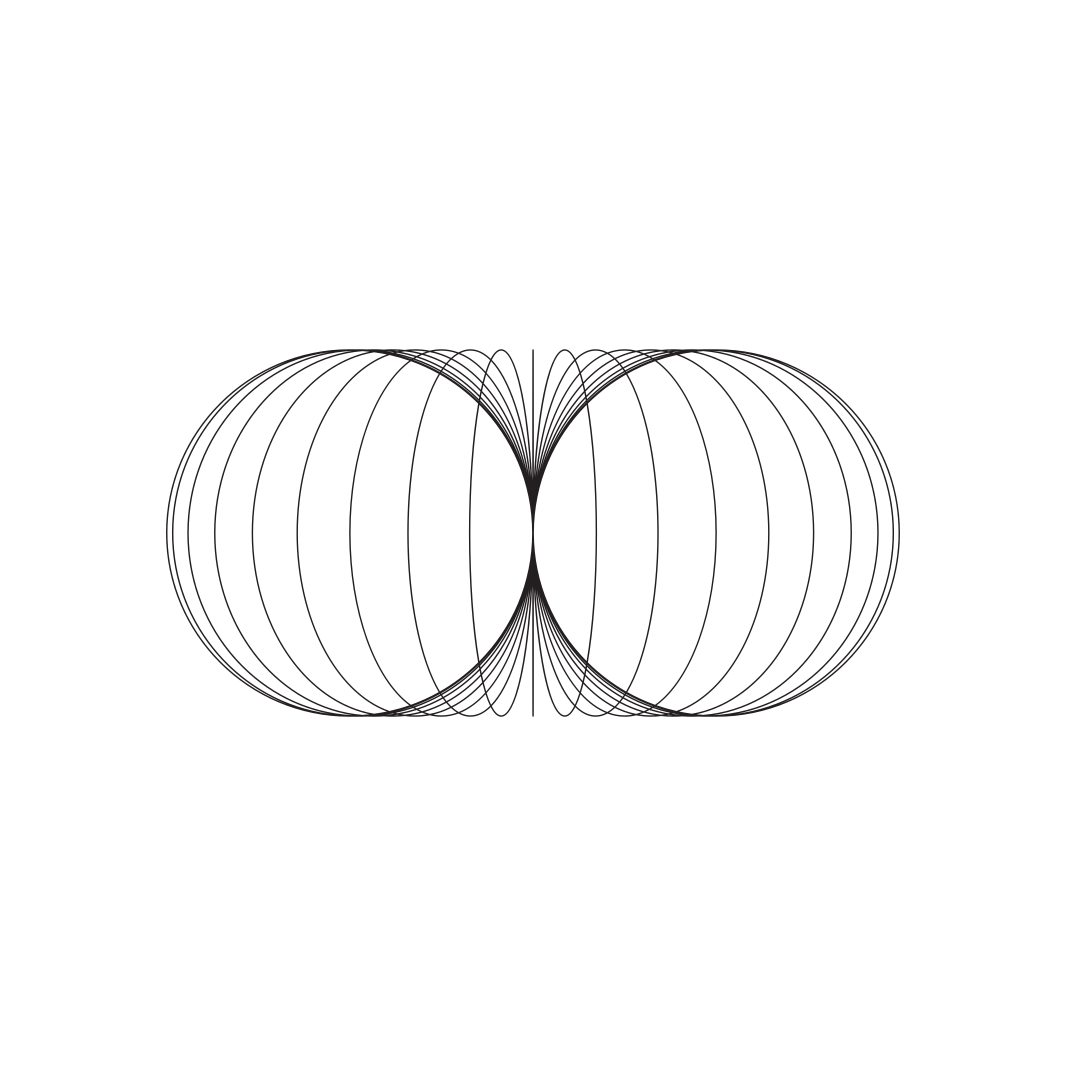
The Universal Energy Pattern
The torus is the fundamental geometric pattern of energy flow in the universe. This donut-shaped form creates a self-sustaining vortex where energy circulates from one pole, flows around the surface, and returns through the opposite pole—a perfect, continuous circulation system.
At the center of every torus lies a point of stillness—the zero-point where energy reverses direction. This center point represents the balance between inflow and outflow, the eye of the cosmic storm where perfect equilibrium exists.
The Pattern Across All Scales
Remarkably, the toroidal field appears at every scale of existence. From the quantum realm to cosmic structures, this same pattern repeats:
- Atomic Level: Electrons orbit the nucleus in toroidal probability clouds
- Human Body: The human heart generates a powerful toroidal electromagnetic field extending several feet from the body
- Earth: Our planet's magnetic field forms a massive torus around the planet, protecting us from solar radiation
- Solar System: The Sun's heliosphere creates a toroidal bubble around our entire solar system
- Galaxies: Spiral galaxies exhibit toroidal rotation patterns and energy flows
This fractal repetition suggests the torus is not merely a shape—it's the fundamental architecture of how energy organizes itself across all dimensions.
Self-Sustaining Vortex Dynamics
The torus is unique because it's self-sustaining. Energy flowing out from the center naturally curves back to flow in again, creating a perpetual circulation. This dynamic balance makes the torus incredibly stable—it can maintain its pattern indefinitely without external input.
The vortex motion creates two complementary spirals: one flowing outward from the center, expanding into manifestation, and one spiraling inward, returning to the source. This mirrors the cosmic dance of creation and dissolution, expansion and contraction, yang and yin.
The Torus in Nature
Beyond energy fields, the toroidal form appears in countless natural structures:
- Apples, oranges, and many fruits grow following toroidal patterns
- Smoke rings and vortex rings in fluids naturally form tori
- Hurricanes and tornadoes exhibit toroidal circulation patterns
- Pine cones and sunflowers spiral in toroidal arrangements
- The human aura is described in many traditions as having a toroidal field structure
Symbolic Meaning
- Infinite Flow: The torus represents perpetual, self-sustaining energy circulation
- Zero-Point Center: The still point at the center symbolizes the source of creation and perfect balance
- Macrocosm-Microcosm: The same pattern appearing at all scales reveals the unity of all existence
- Breath of the Universe: The inflow and outflow mirrors the cosmic breath—creation and dissolution
- Heart-Centered: The heart's toroidal field suggests love as the fundamental organizing force
- Dynamic Equilibrium: Perfect balance achieved through constant motion and exchange
Mathematical Topology: The Genus-One Surface
In topology, the mathematical study of shapes and their properties under continuous deformation, the torus is fundamental:
Genus and the Euler Characteristic: A torus has genus 1—meaning it has one hole. The genus number classifies surfaces topologically: a sphere has genus 0 (no holes), a torus has genus 1 (one hole), a double torus has genus 2 (two holes), and so on.
The Euler characteristic (χ) for a torus is 0, calculated by the formula χ = V - E + F (vertices - edges + faces). For a sphere, χ = 2; for a torus, χ = 0. This zero value reflects the torus's unique balance—neither positively nor negatively curved overall, but exhibiting both types of curvature simultaneously.
Non-Orientable Cousins: While the standard torus is orientable (you can consistently define "inside" and "outside"), twisting it before connecting the ends creates the Klein bottle—a non-orientable surface with no distinct inside or outside. The Klein bottle exists in four dimensions but can be partially visualized in three dimensions.
Flat Torus: Topologically, you can "flatten" a torus into a rectangle where opposite edges are identified—traveling off the right edge brings you back on the left, and going off the top returns you at the bottom. Many classic video games (like Asteroids and Pac-Man) use this topology—the screen wraps around as a flat torus.
Torus Knots: Curves that wind around the torus surface in specific ratios create torus knots—fascinating mathematical objects studied in knot theory. A (p,q)-torus knot winds p times around the tube and q times through the hole.
Plasma Physics: The Tokamak Reactor
The torus finds critical application in humanity's quest for fusion energy:
Magnetic Confinement: A tokamak (Russian acronym for "toroidal chamber with magnetic coils") uses powerful magnetic fields to confine superheated plasma in a toroidal chamber. Plasma—ionized gas at temperatures exceeding 100 million degrees Celsius—would instantly vaporize any material container, so magnetic fields create an invisible "bottle."
Why Toroidal Geometry? The toroidal shape is essential because:
- It has no ends where plasma could escape
- Continuous circulation prevents particle loss
- The nested magnetic field lines create stable confinement
- Helical field lines (spiraling around the torus) provide stability
Fusion Energy Promise: If successful, tokamak fusion could provide virtually limitless clean energy by fusing hydrogen isotopes (deuterium and tritium) into helium—the same process powering the Sun. Major projects like ITER (International Thermonuclear Experimental Reactor) in France and SPARC (MIT/Commonwealth Fusion Systems) are racing to achieve net energy gain from fusion.
Plasma Instabilities: Keeping plasma stable in a tokamak is extraordinarily difficult. Various instabilities—like kink modes, ballooning modes, and edge-localized modes (ELMs)—can disrupt confinement. The toroidal geometry itself helps mitigate some instabilities while creating others, making tokamak design a profound engineering and physics challenge.
Cymatics: Sound Made Visible
Toroidal patterns emerge when sound vibrates physical mediums:
Chladni Patterns and Standing Waves: When sound frequencies vibrate a surface (like a metal plate covered with sand), the particles move away from antinodes (points of maximum vibration) and collect at nodes (points of zero vibration), creating geometric patterns called Chladni figures. Many of these patterns exhibit toroidal or circular symmetry.
Water and Sound: Experiments by Hans Jenny (the father of cymatics) showed that vibrating water at specific frequencies creates toroidal vortices and standing wave patterns. These dynamic tori appear to "breathe"—expanding and contracting in resonance with the sound wave.
Resonance Chambers: Musical instruments like drums and bells create toroidal standing wave patterns when struck. The torus represents the three-dimensional geometry of how sound energy circulates and reinforces itself through resonance.
Acoustic Levitation: Scientists use standing acoustic waves (often exhibiting toroidal field structures) to levitate small objects. The toroidal pressure field creates a stable "trap" where objects float in mid-air—a principle with applications in materials science and pharmaceuticals.
Biological Resonance: Some researchers suggest that biological cells respond to specific acoustic frequencies that create toroidal resonance patterns in cellular fluids, potentially affecting cellular function and health. While controversial, this field explores whether sound and vibrational therapy work through toroidal resonance in living tissues.
Meditation: Entering the Toroidal Field
Working with the torus in consciousness practices:
Heart-Centered Breathing: Visualize a golden torus surrounding your body, with your heart at the center. As you inhale, energy flows in through the top of the torus (above your head), down through your spine to the base, then out and around. As you exhale, the flow continues—energy circulating from feet upward, around, and back through the crown. Your heart is the still point at the center.
Microcosmic Orbit: In Taoist meditation, the microcosmic orbit traces a toroidal path through the body—energy rising up the back (du meridian) and descending down the front (ren meridian). This circulation balances yin and yang, creating internal harmony.
Expanding the Field: Once you feel the toroidal circulation stabilize, allow it to expand outward. Your personal torus extends beyond your physical body—first a few feet, then filling the room, then expanding to include your surroundings. Feel yourself as the still center of an ever-expanding toroidal field of awareness.
Zero-Point Stillness: Focus on the exact center of your torus—the zero-point where energy reverses direction. This is the eye of the storm, the point of absolute stillness amidst infinite motion. Rest in this point. Here, all opposites balance: in/out, up/down, past/future, self/other merge into singular presence.
Related Geometries
Conceptual
Resonates With
- Circle Dot(Both represent wholeness)
- Vector Equilibrium(Dynamic energy flow)
Similar To
- Fibonacci Spiral(Spiraling growth patterns)
- Icosahedron(Water and flow symbolism)