Pentagram
Five-pointed star embodying the golden ratio and representing the human form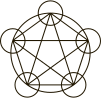
The Golden Proportion in Five
The pentagram is perhaps the most mathematically elegant symbol in sacred geometry. Every line segment in a pentagram divides another in the golden ratio (φ ≈ 1.618). When you draw a pentagram, you are quite literally drawing the golden ratio multiple times in a single, unified form.
The five-pointed star can be drawn with a single continuous line, symbolizing the interconnectedness of all things. It appears naturally in the patterns of apple cores, starfish, and many flowers with five petals—nature's signature written in mathematical perfection.
The Human Microcosm
Leonardo da Vinci's famous Vitruvian Man illustrates how the human body fits within a pentagram—head at the top point, arms and legs at the other four. This isn't mere coincidence; the human form embodies golden ratio proportions throughout its structure.
Ancient philosophers called the pentagram the symbol of the microcosm—the small universe that reflects the greater cosmos. If the universe is built on mathematical harmony, and humans are built on the same proportions, then we are quite literally made in the image of cosmic order.
Symbolic Meanings
- Five Elements: Represents the classical elements (earth, water, fire, air) plus spirit at the top point
- Protection: Used in many traditions as a protective symbol, with the single point upward representing spirit ruling over matter
- Venus Cycle: The planet Venus traces a pentagram in the sky over its 8-year cycle with Earth
- Pythagorean Symbol: The ancient Pythagoreans used it as their secret symbol, recognizing its mathematical perfection
- Mathematical Perfection: Every intersection creates a smaller pentagram, continuing infinitely—self-similar at all scales
- Human Hand: Five fingers, five senses, five-pointed star—the pentagram as a symbol of human agency and manifestation
The Mathematics of Phi
The pentagram is perhaps the most concentrated expression of the golden ratio in geometric form:
Every Line Segment: In a regular pentagram, every line divides every other line it crosses in the golden ratio. If the longest segment is 1, the next smaller segment is 1/φ ≈ 0.618, and the smallest is 1/φ² ≈ 0.382.
Pentagon Diagonals: Draw a pentagon. Connect its five vertices with diagonals (creating the pentagram inside). The ratio of diagonal to side equals φ exactly. This relationship is mathematically provable—not approximate, but precise.
Infinite Regression: At each intersection within a pentagram, a smaller pentagram forms. Within that, another smaller one, continuing infinitely. This creates a phi spiral—the same spiral seen in nautilus shells, galaxies, and hurricanes.
The Golden Gnomon: The isosceles triangles formed by the pentagram's lines are called "golden gnomons"—triangles whose ratio of side to base equals φ. These triangles can tile infinitely using Penrose tiling patterns, creating non-repeating yet perfectly ordered surfaces.
Venus: The Celestial Pentagram
One of nature's most astonishing geometric performances occurs in the dance between Earth and Venus:
The Eight-Year Cycle: Venus orbits the Sun in approximately 225 days, while Earth takes 365 days. Over an eight-year period, Venus makes 13 orbits while Earth makes 8. The ratio 13:8 approximates the golden ratio (φ ≈ 1.618), as these are consecutive Fibonacci numbers.
Five-Petaled Rose: If you track the points where Venus makes inferior conjunction with Earth (passing between Earth and Sun), these five points trace a nearly perfect pentagram in space over eight years. Plot these positions and you create a five-petaled rose pattern.
Ancient Observations: The Mayans tracked Venus with extraordinary precision, building their calendar systems around its cycles. The ancient association of Venus with love, beauty, and the divine feminine connects to the pentagram's golden ratio—the mathematics of beauty encoded in planetary motion.
Mathematical Harmony: That the Earth-Venus dance creates a pentagram isn't arbitrary—it's the result of orbital resonance governed by gravitational dynamics. The cosmos literally performs sacred geometry through the laws of physics.
Five in Nature
Five-fold symmetry appears throughout the natural world, especially in living organisms:
Five-Petaled Flowers: Apple blossoms, wild roses, cherry blossoms, and countless other flowers display five petals. While six-fold symmetry dominates inorganic crystals, five-fold symmetry is a signature of organic life.
Starfish and Echinoderms: Sea stars, sea urchins, and sand dollars all exhibit five-fold radial symmetry—a body plan found throughout the echinoderm phylum. Their five "arms" or sections reflect pentagonal geometry at the biological level.
The Apple's Secret: Slice an apple horizontally through its center, and you'll find a perfect five-pointed star formed by the seed chambers—the pentagram hidden within the fruit, revealed only when you look from the right perspective.
Human Hand: Five fingers, five toes—the pentagram appears in our own bodies. Leonardo da Vinci's Vitruvian Man can be inscribed within a pentagram, with head and limbs marking the five points. We are literally built on five-fold geometry.
The Pythagorean Pentagram
For the ancient Pythagoreans, the pentagram was their most sacred symbol:
The Sacred Sign: Members of the Pythagorean Brotherhood used the pentagram as their secret recognition symbol, calling it the "Pentalpha" (five alphas) or "Health" (ὑγιεία - hygieia in Greek).
Mathematical Discovery: The Pythagoreans discovered that the diagonal of a pentagon is incommensurable with its side—meaning their ratio cannot be expressed as a fraction of whole numbers. This discovery of irrational numbers (φ specifically) was revolutionary and, according to legend, so disturbing that they kept it secret.
Hippasus and the Golden Ratio: Legend says that Hippasus, a Pythagorean who revealed the secret of irrational numbers to outsiders, was drowned at sea as divine punishment. Whether true or not, the story reveals how profound and sacred they considered the pentagram's mathematical properties.
Universe as Number: The Pythagoreans believed "all is number"—that mathematical relationships underlie all reality. The pentagram, embodying φ and containing infinite self-similarity, was proof that divine intelligence uses geometric perfection as its creative language.
Upright and Inverted: Spirit and Matter
The pentagram's orientation carries symbolic meaning:
Upright Pentagram (one point up): Represents spirit ruling over the four elements of matter. The single point at top symbolizes consciousness, divinity, or the higher self governing the physical realm. This is the traditional "white magic" or spiritual orientation.
Inverted Pentagram (two points up): Represents matter ascendant over spirit—the material world or physical desires dominating. In some traditions this symbolizes initiation into deeper mysteries, confronting the shadow, or the descent of spirit into matter. In Western occultism, it became associated with the "dark path" or "left-hand path."
The Middle Path: Some traditions teach that both orientations are necessary—spirit must descend into matter (inverted) so that matter can be refined and ascend (upright). The two positions represent the eternal cycle of involution and evolution, descent and ascent.
Intention Matters: Symbols are tools—their meaning comes from the consciousness of the user. A pentagram is geometry, neutral in itself. Its power comes from the intention and understanding brought to it.
Protective Symbolism
Throughout history, the pentagram has been used as a symbol of protection:
Medieval Christianity: In medieval times, Christians used the pentagram to represent the five wounds of Christ or the five joys of Mary. It appeared on churches and manuscripts as a protective symbol against evil.
Solomon's Seal: Some traditions associate the pentagram with King Solomon, who according to legend used a magical ring inscribed with a pentagram (or hexagram) to command demons and spirits.
Wiccan Pentacle: In modern Wicca and neopagan traditions, a pentagram within a circle (pentacle) represents the unity of all elements within the wholeness of spirit. Worn as jewelry or drawn ritually, it symbolizes protection and balance.
The Logic of Protection: Why would a geometric form provide protection? Symbolically, the pentagram represents order, harmony, and mathematical perfection. To invoke it is to invoke the principle that consciousness (spirit/top point) governs and organizes the chaos of material elements—protection through alignment with cosmic order.
Meditation: The Five-Pointed Path
Working with pentagram energy in meditation:
Five Element Integration: Place one element at each point: Earth (lower left), Water (lower right), Fire (upper left), Air (upper right), Spirit (top). Meditate on bringing all five into balance—grounding (earth), feeling (water), transforming (fire), thinking (air), all unified in consciousness (spirit).
The Golden Proportion Practice: Visualize a pentagram and focus on the relationship between its segments. Contemplate how each part relates to the whole through φ—no part exists in isolation, all are proportioned in perfect harmony. Let this mathematical truth inform your sense of self within the cosmos.
Drawing the Pentagram: In ceremonial magic traditions, practitioners "draw" a pentagram in the air or imagination, starting from different points for different purposes (invoking vs. banishing, different elements). Try this: trace a pentagram slowly and deliberately, feeling each line connect heaven and earth, spirit and matter.
Pentagram as Self: You are the pentagram—head (spirit), two arms (air/fire - action and passion), two legs (earth/water - foundation and emotion). Meditate on yourself as a five-pointed star, a human pentagram walking the earth, embodying cosmic mathematics in flesh.
Related Geometries
Mathematical
Ratio Related
- Golden Ratio(Pentagram perfectly embodies phi)
- Dodecahedron(Pentagonal face relationships)
Conceptual
Related by Element
- Tetrahedron(Fire element associations)