Golden Ratio
Divine proportion (φ ≈ 1.618) that appears throughout nature and sacred architecture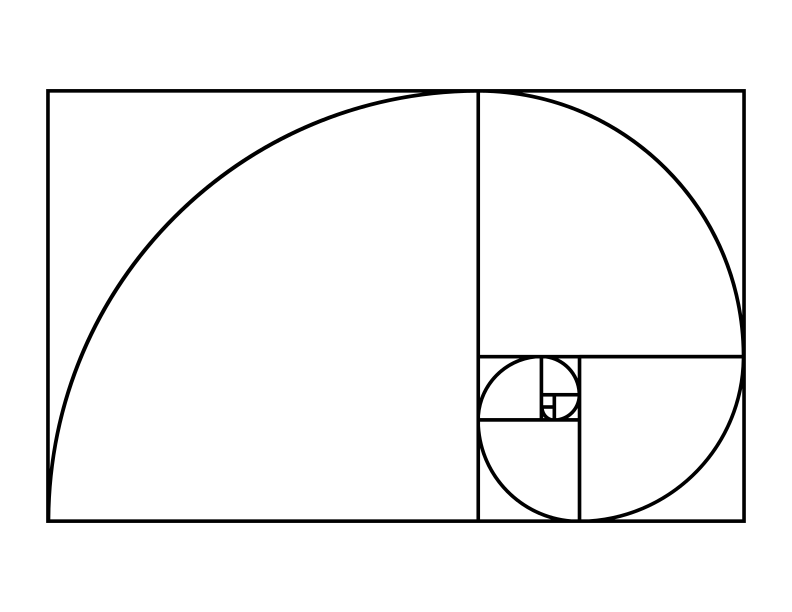
The Mathematics of Beauty
The Golden Ratio is an irrational number, approximately 1.61803398875... It is defined by a simple yet profound relationship:
φ = (1 + √5) / 2
When a line is divided at the Golden Ratio, the whole is to the larger part as the larger part is to the smaller part.
Unique Properties:
- φ + 1 = φ²
- φ - 1 = 1/φ
- φ² = φ + 1
- 1/φ = φ - 1
The Fibonacci Sequence:
0, 1, 1, 2, 3, 5, 8, 13, 21, 34, 55, 89...
Each number is the sum of the previous two. As the sequence progresses, the ratio between consecutive numbers approaches φ.
The Pattern of Growth
The Golden Ratio appears repeatedly in nature, particularly in growth patterns:
Flora:
- Flower petals (lilies have 3, buttercups 5, delphiniums 8, marigolds 13, asters 21, daisies 34, 55 or 89)
- Pine cone spirals
- Sunflower seed arrangements
- Rose petal spirals
- Leaf arrangements (phyllotaxis)
Fauna & Astronomy:
- Nautilus shell spiral
- Spiral galaxies
- Hurricane formations
- DNA molecule (34 Ångströms long, 21 Ångströms wide)
- Human face proportions
- Finger bones ratios
Art, Architecture & Design
Artists and architects have used the Golden Ratio for centuries to create aesthetically pleasing, harmonious compositions:
- The Parthenon: The ancient Greek temple's facade can be divided into golden rectangles, creating visual harmony.
- Great Pyramid of Giza: The ratio of the height to half the base approximates φ, whether by design or coincidence.
- Leonardo da Vinci: Used the Golden Ratio extensively in paintings like the Mona Lisa and The Last Supper.
- Modern Design: Apple, Twitter, and other tech companies use golden ratio proportions in logo and interface design.
- Music: Compositions by Mozart, Beethoven, and Debussy incorporate golden ratio proportions in timing and structure.
The Golden Spiral
When you create squares based on Fibonacci numbers and connect their corners with an arc, you create the Golden Spiral—a logarithmic spiral that grows outward by a factor of φ for every quarter turn.
This spiral appears in:
- Nautilus shells
- Spiral galaxies like the Milky Way
- Hurricane and tornado formations
- Cochlea of the human ear
- Unfurling fern fronds
- Spider webs
Why this spiral? It represents the most efficient growth pattern—expanding without changing shape, maintaining the same proportions at any scale. Nature favors it because it optimizes space while minimizing energy expenditure.
The Human Blueprint
The idea that the Golden Ratio appears throughout human anatomy has been popular since the 19th century, but scientific evidence tells a more nuanced story:
The Claims:
- Navel to floor / head to navel ≈ φ
- Facial features in golden proportion
- Finger bones in φ ratios
The Reality: Scientific studies have found no convincing evidence that the golden ratio is fundamental to human proportions or facial beauty. Leonardo da Vinci's famous Vitruvian Man actually uses whole number ratios, not φ—Leonardo never claimed to use the golden ratio in his studies of human anatomy.
Why the Myth Persists: The human body contains many ratios between 1 and 2, so if you measure enough combinations, you'll inevitably find some close to 1.618 by chance alone. This doesn't mean φ is a biological blueprint—it's more likely a case of finding what we're looking for.
Cultural Significance: While not scientifically validated, the idea of golden proportions in humanity reflects our deep desire to find mathematical harmony connecting us to nature's patterns. This metaphorical or aspirational understanding has value even if the literal claims don't hold up to measurement.
Why Does Nature Use φ?
The Golden Ratio may be nature's solution to fundamental optimization problems:
Efficient Packing: The golden angle (≈137.5°, derived from φ) allows seeds, leaves, and petals to pack with minimal overlap, maximizing sunlight exposure and space utilization.
Optimal Growth: The Golden Spiral allows organisms to grow while maintaining the same proportions—crucial for shells, horns, and other structures that grow continuously.
Aesthetic Appeal: Humans find φ proportions pleasing because our brains are wired to recognize efficient, optimal patterns. What we call beauty may be our recognition of mathematical perfection.
Fractal Self-Similarity: The ratio maintains the same proportions at every scale, creating visual harmony and structural stability.
Related Geometries
Mathematical
Ratio Related
- Pentagram
- Dodecahedron
- Icosahedron
- Fibonacci Spiral(Fibonacci sequence generates phi)
- Vesica Piscis
Conceptual
Resonates With
- Flower of Life(Divine proportion in nature)