The Icosahedron: Flow of Water
The icosahedron embodies the element of Water—emotion, fluidity, and adaptability. It is the shape of flow and transformation, rolling smoothly like water itself.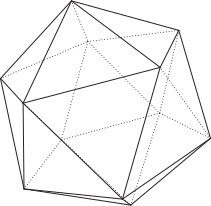
Visual Representations

Mathematical Properties
Associations
Symbolic Properties
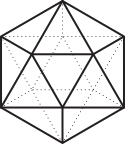
With twenty triangular faces, the icosahedron is the most spherical of the Platonic Solids—approaching the perfect fluidity of a sphere. This quality makes it the ideal representation of water. In sacred geometry, it symbolizes:
Key Associations:
- Water and emotions, the flow of feeling
- The Sacral Chakra, center of creativity and emotion
- Transformation and adaptability, like water taking any shape
- Life force and the primordial waters of creation
Mathematical Insights
The icosahedron is the dual of the dodecahedron—where spirit (dodecahedron) meets matter through emotion (icosahedron). Together they represent the dance between consciousness and feeling, thought and sensation.
It has the greatest number of faces among the Platonic Solids, giving it the largest surface area relative to its volume. This makes it the most efficient for containing and moving—just like water molecules arranging themselves for optimal flow.
Dual to the Dodecahedron
The icosahedron and dodecahedron are geometric duals—perfect complements that represent the relationship between Water and Ether, emotion and consciousness:
Twenty and Twelve: The icosahedron's 20 triangular faces transform into the dodecahedron's 12 pentagonal faces. Twenty represents complete manifestation (4 elements × 5 senses), while twelve represents cosmic order (zodiac, months, apostles).
Water meeting Spirit: The icosahedron (Water) flows and adapts, while its dual the dodecahedron (Ether) represents the cosmic container within which water flows. Emotion (icosahedron) moves through consciousness (dodecahedron).
Mutual Generation: Connect the centers of a dodecahedron's 12 faces to create an icosahedron. Connect the centers of an icosahedron's 20 faces to create a dodecahedron. They eternally give birth to each other—form and flow in perfect reciprocity.
Geodesic Domes: Buckminster Fuller's Vision
Buckminster Fuller discovered that the icosahedron is the most efficient way to enclose space with the least material:
Geodesic Geometry: A geodesic dome divides an icosahedron's faces into smaller triangles, creating a sphere-like structure of exceptional strength. The load distributes evenly across all points—no single element carries excessive stress.
Maximum Volume, Minimum Surface: The icosahedron approaches the efficiency of a sphere (maximum volume per surface area) while maintaining structural rigidity. This makes it ideal for architecture requiring large, open interiors.
Famous Examples:
- Spaceship Earth (EPCOT): The iconic sphere is actually a geodesic structure based on icosahedral symmetry
- Biosphere 2: The experimental ecosystem used geodesic domes to maximize interior space
- Radomes: Military radar installations use geodesic designs for strength and minimal interference
Fuller's Philosophy: Fuller called the icosahedron-based geodesic the "strongest, lightest, most efficient means of enclosing space." He saw it as humanity's geometric tool for sustainable architecture—doing more with less.
Viral Capsids: Geometry of Life
Many viruses use icosahedral geometry to construct their protein shells (capsids):
Why Icosahedra? The icosahedral shape allows viruses to build maximum volume with minimum genetic information. Rather than coding for 20 different proteins, they code for one protein that repeats in icosahedral symmetry—elegant efficiency.
Examples:
- Adenovirus: Perfect icosahedral capsid, 20 triangular faces
- Poliovirus: Icosahedral geometry protects its genetic material
- Herpes Simplex: Combines icosahedral core with outer envelope
- Bacteriophages: Many use icosahedral "heads" to store DNA
Symmetry and Survival: The icosahedral structure provides viruses with remarkable stability. The even distribution of forces across all faces allows these microscopic particles to survive harsh environments until they find a host.
Quasi-Crystalline: Virus capsids demonstrate "quasi-crystalline" order—geometric patterns that bridge the gap between crystal and fluid, between order and chaos. The icosahedron enables this threshold state.
Water: The Icosahedral Molecule
Water's unique properties may relate to icosahedral structuring:
Water Clusters: Research suggests water molecules organize into clusters, and some of these clusters exhibit icosahedral geometry. These structures may explain water's anomalous properties—why ice floats, why water has such high surface tension.
Tetrahedral Bonding, Icosahedral Clusters: Individual H₂O molecules bond tetrahedrally (one oxygen, two hydrogen, two lone pairs), but at larger scales, these tetrahedral units may organize icosahedrally—local geometry creating global pattern.
Memory and Structure: Some researchers propose that water's icosahedral clusters could store and transmit information through geometric patterning. While controversial, this idea explores how geometry might encode meaning in liquid form.
Life's Medium: That water—the medium of all biological life—may organize icosahedrally connects the icosahedron to life itself. Flow, adaptability, and the capacity to carry and transmit patterns: water as living geometry.
Planetary Grids and Earth Geometry
Some researchers propose that Earth's energy patterns follow icosahedral geometry:
The Planetary Grid: Theories suggest Earth's crust features points and lines following icosahedral and dodecahedral symmetry—creating a global geometric matrix connecting sacred sites, anomalies, and energy vortices.
Twelve Pentagonal Plates: Some geophysicists note that Earth's major tectonic plates roughly approximate a dodecahedral arrangement, with the dual icosahedral pattern emerging from plate boundaries and volcanic activity.
Buckminster Fuller's Dymaxion Map: Fuller created a world map projected onto an icosahedron, then unfolded. This projection shows continents with minimal distortion—geometry revealing geography's true relationships.
Ancient Knowledge?: The appearance of icosahedral and dodecahedral awareness in ancient cultures (Plato, Pythagoreans, mystery schools) suggests they may have intuited Earth's geometric nature without modern instruments.
The D20: Gaming and Chance
The twenty-sided die brings icosahedral geometry into games and divination:
Random, Yet Fair: Each face has equal probability, making the icosahedron the fairest twenty-option randomizer. Its near-spherical shape allows it to roll freely while landing definitively.
Tabletop Gaming: Dungeons & Dragons and other role-playing games use the d20 as their primary die—fate and fortune determined by icosahedral geometry. Rolling a "natural 20" means the icosahedron blessed your action.
Sacred Randomness: Using geometric forms for divination has ancient roots. The icosahedron represents the understanding that even chance operates through patterns—that randomness itself has structure.
Twenty Possibilities: Twenty outcomes maps to many significant systems: 20 amino acids, the 20th Tarot card (Judgment), base-20 counting systems (Mayan). The icosahedron geometrically encodes this twenty-fold completeness.
Radiolaria: Nature's Glass Sculptures
Radiolaria—single-celled marine organisms—build intricate glassy skeletons following icosahedral geometry:
Microscopic Perfection: Under a microscope, radiolaria reveal astonishing geometric beauty. Many species construct icosahedral shells from silicon dioxide (glass), creating living sacred geometry.
Evolutionary Geometry: These organisms have evolved icosahedral forms over millions of years, suggesting this geometry provides survival advantages—structural strength, efficient materials use, optimal surface-to-volume ratio for nutrient exchange.
Form and Function: The icosahedral skeleton provides both protection and organization. The geometric framework supports the organism's body while maximizing contact with surrounding water for feeding and respiration.
Ernst Haeckel: The 19th-century biologist Ernst Haeckel documented radiolaria in stunning detail, revealing to the world that nature operates through pure geometric principles even at microscopic scales.
Meditation: The Sphere of Infinite Flow
Working with icosahedral energy in meditation:
Emotional Fluidity: Visualize an icosahedron at your sacral chakra (emotional center). Feel its twenty faces representing the full spectrum of emotional expression. Let it spin, allowing emotions to flow and transform without attachment.
Adaptive Awareness: The icosahedron teaches flexibility. Like water, consciousness can take any shape while maintaining its essence. Meditate on the icosahedron to cultivate adaptive intelligence—responding appropriately to any situation.
Sacred Sphere: As the most sphere-like Platonic Solid, the icosahedron represents approaching perfection while maintaining form. Visualize it expanding into a sphere—form dissolving into infinite possibility, then condensing back into sacred geometry.
Group Coherence: The icosahedron's efficiency (maximum volume, minimum surface) makes it ideal for group meditation. Visualize participants at each vertex of an icosahedral field, creating a container for collective consciousness.
Related Geometries
Structural
Dual
- Dodecahedron(Icosahedron-dodecahedron duality)
Appears In
Mathematical
Ratio Related
- Golden Ratio(Triangular faces contain phi ratios)
Conceptual
Similar To
- Torus(Both represent flow and water)