Vesica Piscis
The intersection of two circles, representing duality and the portal of creation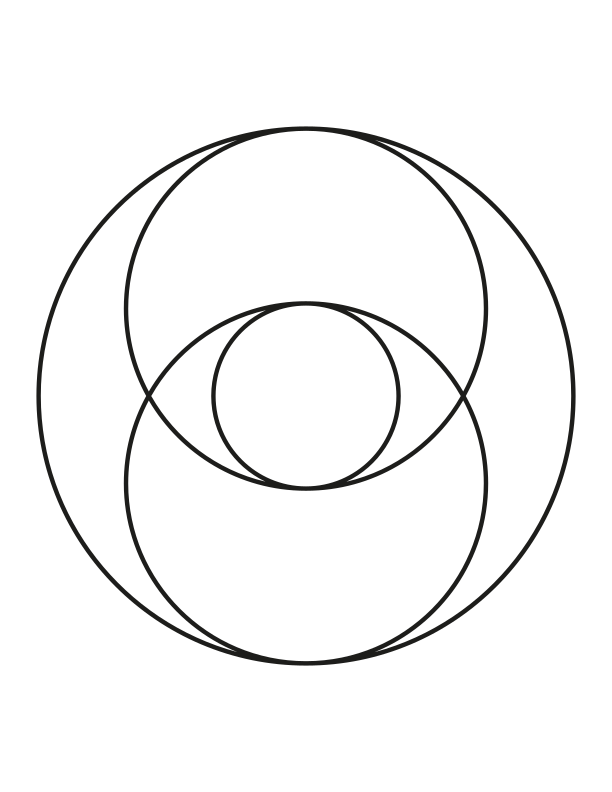
The Portal of Creation
The Vesica Piscis is formed when two circles of equal size overlap such that the center of each circle touches the circumference of the other. This simple geometric operation creates the almond-shaped "vesica" in the center—a shape that has profound symbolic and mathematical significance.
It is called the "womb of geometry" because all other geometric forms can be derived from it. The vesica generates the triangle, square, pentagon, and all platonic solids through continued geometric construction.
Foundation of Sacred Geometry
The Vesica Piscis is the fundamental building block of the Seed of Life and Flower of Life patterns. When you create the Seed of Life by drawing seven circles, you're actually creating six vesica piscis formations radiating from the center.
The mathematical ratio of the width to height of the vesica piscis is 1:√3 (approximately 1:1.732), connecting it to the geometry of equilateral triangles and hexagons.
Symbolic Meanings
- Divine Feminine: The almond shape represents the vulva, womb, and portal of birth
- Duality & Unity: Two separate circles merging into one shared space, representing the union of opposites
- Christ Consciousness: In Christian iconography, the vesica piscis often frames Christ or Mary, symbolizing divine manifestation
- The Fish: "Vesica Piscis" means "bladder of the fish" in Latin, connecting to early Christian fish symbolism
- Sacred Architecture: Gothic pointed arches and window designs are based on the vesica piscis shape
The Mathematical Beauty of √3
The vesica piscis embodies the square root of 3 (√3 ≈ 1.732), one of mathematics' most important irrational numbers:
The Ratio: When two circles of radius 1 overlap to form a vesica piscis, the width of the vesica is exactly 1, while its height is √3. This 1:√3 ratio appears throughout nature and geometry.
Connection to the Equilateral Triangle: Draw lines connecting the two circle centers to the top and bottom points of the vesica, and you create a perfect equilateral triangle. The vesica's height equals the altitude of this triangle—revealing how √3 emerges from hexagonal geometry.
Hexagonal Packing: The vesica piscis is the space created when circles pack in hexagonal formation—the most efficient way to pack circles on a plane. Honeycomb cells, soap bubbles, and biological structures naturally form this pattern, with vesica piscis shapes appearing at every intersection.
From Two to Three: The vesica demonstrates how duality (2 circles) gives birth to trinity (the triangle). This geometric truth mirrors spiritual teachings across cultures: from the One comes the Two (duality), and from their union emerges the Three (creation).
Sacred Architecture: The Pointed Arch
Gothic cathedrals—those soaring masterpieces of medieval Europe—are built on vesica piscis geometry:
The Gothic Arch: The distinctive pointed arch of Gothic architecture is constructed by drawing two circles whose centers lie on opposite sides of the arch's base. The vesica piscis formed by their intersection creates the arch's elegant pointed curve.
Structural Innovation: This wasn't just aesthetic—pointed arches distribute weight more efficiently than Roman round arches, allowing medieval architects to build taller walls with larger windows. Sacred geometry enabled practical engineering breakthroughs.
Cathedral Windows: Rose windows and lancet windows in Gothic cathedrals use vesica piscis proportions extensively. Chartres Cathedral, Notre-Dame de Paris, and Westminster Abbey showcase these sacred proportions in stone and stained glass.
The Mandorla in Art: The almond-shaped halo surrounding Christ, Mary, or saints in medieval Christian art is called a mandorla (Italian for "almond")—directly derived from the vesica piscis. This places the divine figure within the geometric space of creation and unity.
Biology: The First Division
The vesica piscis appears at the very beginning of life:
Cell Division: When a single cell divides into two, it briefly forms a vesica piscis shape—two circles (the daughter cells) overlapping at their moment of separation. The first geometry of multi-cellular life is the vesica.
The Human Eye: The eye itself is a vesica piscis—two curved surfaces (cornea and visible sclera) meeting to form the almond shape we recognize as the eye's outline. The eye, our window to reality, takes the form of sacred geometry's portal.
Leaves and Seeds: Many leaves (almond, willow) and seeds take vesica piscis forms—nature's way of maximizing efficiency in growth patterns. The shape provides optimal strength with minimal material.
Meditation: Portal Between Worlds
Working with vesica piscis energy in meditation:
Union of Opposites: Visualize two circles—one representing masculine/active/solar energy, the other feminine/receptive/lunar energy. Watch them overlap to create the vesica piscis, the sacred space where polarities unite without losing their distinctness.
Breath of Creation: The vesica can represent the breath—inhalation (one circle) and exhalation (the other circle) meeting in the sacred pause between breaths. This pause, this vesica moment, is where transformation occurs.
Dimensional Gateway: Some meditation traditions use the vesica piscis as a visual portal for consciousness exploration—the almond shape becomes a doorway through which awareness can travel between states, dimensions, or aspects of self.
Womb of Potential: Meditate within the vesica piscis as the womb of all possibility. Everything that exists emerged from this first intersection—you sit in the geometric space of pure creative potential, the pregnant void from which all forms arise.
Related Geometries
Structural
Derived From
- Circle Dot(Formed by two overlapping circles)
Transformational
Transforms Into
- Seed of Life(Multiple vesicas form seed)
Mathematical
Ratio Related
- Golden Ratio(Contains phi proportions)