Tree of Life
Ancient Kabbalistic diagram of ten spheres and twenty-two paths representing the structure of creation and the path of spiritual ascent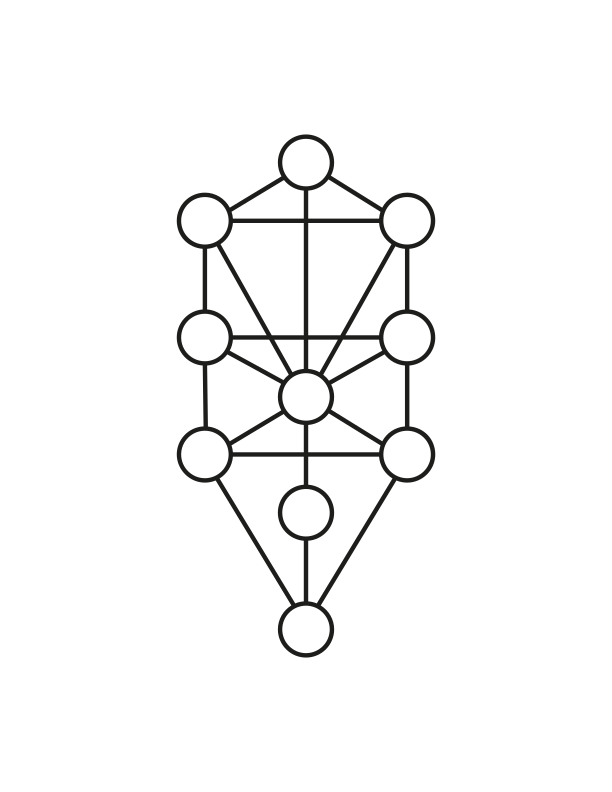
The Map of Creation
The Tree of Life, or Etz Chaim in Hebrew, is the central symbol of Kabbalah—the mystical tradition of Judaism. This sacred diagram maps the descent of divine energy from the infinite source (Ein Sof) into material manifestation, and simultaneously shows the path of return—the journey of spiritual ascent back to unity.
The Tree consists of ten spheres called Sephiroth (singular: Sephirah), connected by twenty-two paths. Each Sephirah represents a different aspect of divine consciousness and a stage in the creative process. Together, they form a complete map of reality—from the highest spiritual realms to the physical world we inhabit.
The Ten Sephiroth
The ten Sephiroth represent ten divine emanations or attributes through which the infinite becomes finite, spirit becomes matter. Arranged in three pillars, they form a balanced structure of creative forces:
1. Kether (Crown): The first emanation, closest to the infinite source, pure divine will
2. Chokmah (Wisdom): Raw creative force, divine masculine principle, the father
3. Binah (Understanding): Divine feminine, the cosmic mother who gives form to creation
4. Chesed (Mercy): Loving-kindness, expansion, grace, and boundless generosity
5. Geburah (Severity): Strength, judgment, discipline, the power of limitation
6. Tiphereth (Beauty): Harmony, balance, the heart center where all forces unite
7. Netzach (Victory): Endurance, emotion, art, and the drive to persist
8. Hod (Glory): Intellect, communication, analysis, and mental clarity
9. Yesod (Foundation): The subconscious, dreams, the astral realm, connection to the physical
10. Malkuth (Kingdom): The physical world, earth, manifestation, where spirit becomes matter
The Twenty-Two Paths
Connecting the ten Sephiroth are twenty-two paths, each corresponding to a letter of the Hebrew alphabet and a card in the Major Arcana of the Tarot. These paths represent the transitions between states of consciousness and the channels through which divine energy flows.
While the Sephiroth represent states of being, the paths represent processes of becoming. To walk the Tree is to traverse these paths, experiencing transformation as consciousness moves between different modes of awareness and understanding.
The Three Pillars
The Tree's structure reveals three vertical pillars that represent fundamental cosmic forces:
- Left Pillar (Severity): Feminine force—Binah, Geburah, Hod—representing structure, limitation, and form
- Right Pillar (Mercy): Masculine force—Chokmah, Chesed, Netzach—representing expansion, creativity, and energy
- Middle Pillar (Equilibrium): Balance point—Kether, Tiphereth, Yesod, Malkuth—the path of harmony between opposites
Spiritual development involves balancing these forces within oneself—integrating expansion with limitation, mercy with severity, masculine with feminine—to walk the middle path of equilibrium.
Hidden Within the Flower of Life
Remarkably, the Tree of Life can be perfectly overlaid onto the Flower of Life pattern. By selecting specific intersection points within the Flower, the ten Sephiroth emerge naturally. This geometric relationship suggests that the Kabbalistic wisdom is not separate from sacred geometry—both describe the same fundamental patterns underlying creation itself.
Symbolic Meaning
- Path of Spiritual Ascent: A map for consciousness evolution from material to divine awareness
- Divine Emanations: Shows how the infinite descends into finite manifestation through ten stages
- Microcosm and Macrocosm: Reflects both the structure of the cosmos and the human soul
- Four Worlds: Can be divided into four realms—Atziluth (divine), Briah (creative), Yetzirah (formative), Assiah (physical)
- Balance of Opposites: Teaches integration of masculine/feminine, mercy/severity, expansion/contraction
- Universal Template: Found hidden in the Flower of Life, revealing the unity of all mystical traditions
The Four Worlds: Layers of Reality
Kabbalistic cosmology organizes the Tree of Life into four distinct worlds or realms, each representing a different level of divine manifestation:
Atziluth (World of Emanation): The highest world, closest to Ein Sof (the infinite). This is pure divinity, the realm of archetypes before they take any form. Here consciousness exists as pure potential, undifferentiated light. Atziluth corresponds to the element of Fire and the divine name YHVH (Tetragrammaton). In the Tree, Atziluth is associated primarily with Kether, though some systems place all Sephiroth in all four worlds.
Briah (World of Creation): The world of pure intellect and the divine throne. Here, archetypal ideas begin to take conceptual form, though they remain purely spiritual without material substance. This is the realm of archangels and pure thought. Briah corresponds to Air—ideas moving like wind. The creative act begins here as divine consciousness starts to differentiate.
Yetzirah (World of Formation): The astral or formative world where concepts take on energetic form. Angels, emotions, and psychic forces exist in Yetzirah. This is the realm of dreams, visions, and subtle energies—the interface between pure spirit and dense matter. Yetzirah corresponds to Water—fluid, emotional, taking shape but not yet solid. Much of magical and meditative work occurs in this realm.
Assiah (World of Action/Making): The physical world we inhabit—material reality where spirit becomes matter. Assiah corresponds to Earth—solid, dense, tangible. This is where divine creative energy completes its descent and takes physical form. Yet even here, at the most "lowly" level, the divine spark remains hidden within matter, waiting to be recognized and elevated back toward its source.
Interconnection: Each world interpenetrates the others—Malkuth (Kingdom) of the higher world becomes Kether (Crown) of the world below. Reality is a continuous descent from pure spirit to dense matter, and ascent from matter back to spirit. The spiritual journey involves consciously traversing these worlds, ascending from Assiah through Yetzirah and Briah, ultimately reuniting with Atziluth.
Pathworking: Walking the Tree
Pathworking is a meditative practice involving conscious exploration of the Tree of Life's structure:
The Middle Pillar Exercise: A foundational Kabbalistic practice involves awakening the central column of the Tree within your body:
- Stand or sit with spine straight
- Visualize Kether (brilliant white light) at the crown of your head
- Draw light downward to Daath (the hidden Sephirah at your throat)—knowledge and connection
- Continue to Tiphereth (golden radiance) at your heart center
- Draw light down to Yesod (violet or silver) at your pelvis
- Ground into Malkuth (earth tones—russet, olive, black) at your feet
Circulate energy up and down this central pillar, experiencing the flow of divine energy through your body.
Traversing the Paths: Advanced pathworking involves meditation on the 22 paths connecting the Sephiroth:
- Choose a path (e.g., the path from Malkuth to Yesod—corresponds to Tarot card "The Moon")
- Visualize yourself standing before a doorway or gate at the starting Sephirah
- Enter the path and journey along it, observing images, symbols, and experiences that arise
- Each path has specific correspondences—colors, sounds, divine names, angelic beings
- Arrive at the destination Sephirah, integrating the transformation the path provides
- Return to ordinary consciousness and record your experience
Ascending the Tree: The spiritual path traditionally begins at Malkuth (physical world) and ascends through increasingly subtle Sephiroth toward Kether (divine crown). This journey takes years or lifetimes, representing progressive refinement of consciousness.
Practical Application: Beyond meditation, the Tree provides a diagnostic tool for life balance. Where are you overexpressing or underexpressing certain Sephirotic energies? Too much Chesed without Geburah becomes undisciplined permissiveness. Too much Hod without Netzach becomes cold analysis without feeling. The Tree teaches dynamic balance.
Mathematical and Geometric Foundations
The Tree of Life encodes profound mathematical relationships:
The Number Ten: The ten Sephiroth represent completion in the decimal system—the return to unity (1+0=1) at a higher level. Ten is also the tetraktys in Pythagorean tradition—the triangular number containing 1+2+3+4=10, representing the sum of the first four numbers and the foundation of all harmony.
The Twenty-Two Paths: Twenty-two paths, twenty-two Hebrew letters, twenty-two Major Arcana cards—this number appears throughout Kabbalistic and esoteric systems. Mathematically, twenty-two is the number of edges in a complete graph connecting 5 vertices (though the Tree has 10 vertices and 22 selected connections, not all possible connections).
Sacred Ratios: The spacing and proportions of Sephiroth in various traditional diagrams often encode the golden ratio (φ ≈ 1.618). The relationship between Kether-Tiphereth-Yesod-Malkuth (the central axis) frequently displays harmonic proportions found in music and architecture.
Overlay with the Flower of Life: When the Tree of Life is precisely overlaid on the Flower of Life pattern, the ten Sephiroth align perfectly with specific intersection points. This geometric correspondence suggests both symbols describe the same underlying reality through different cultural lenses—one through Jewish mysticism, the other through universal geometric principles.
Graph Theory: In modern mathematics, the Tree of Life can be analyzed as a weighted directed graph with 10 nodes (Sephiroth) and 22 edges (paths). Each path has attributes (Tarot correspondence, Hebrew letter, elemental/planetary association), making it a rich, multi-dimensional data structure for mapping consciousness.
Related Geometries
Structural
Appears In
Conceptual
Resonates With
- Metatron's Cube(Both map divine emanation)
Similar To
- Sri Yantra(Sacred geometric cosmologies)